I do not know which to prefer,
The beauty of inflections
Or the beauty of innuendoes,
The blackbird whistling
Or just after.
Wallace Stevens gives us Thirteen Ways of Looking at a Blackbird and in the comment-space of this post, Shweta says, 'Everybody who ever sees a blackbird should give us a new way.'
So, have you ever seen a blackbird?
Sunday, September 14, 2008

Friday, August 22, 2008
कार्यक्षेत्र अध्ययन
घटना १: A Shikra-like bird comes gliding by, “Arrey! Peregrine Falcon!” Mayhem breaks out। Some ten birders with scopes, binoculars and cameras with absurdly long lenses chase the bird as it wings its way to safety. Four twenty somethings stare in astonishment at the others as they recede into the distance leaving a cloud of dust billowing in their wake. The four plonk themselves on the ground. P__ opens her backpack, digs out four Twix bars and passes them around. They munch pensively and wait for the others to return with news. Suddenly a call sounds in the distance, “Arrey! Eurasian Sparrowhawk!” The four look up and spot the same bird flying past। Jumble of people, dust, cameras and binoculars returns and passes by.P__ looks at N___. N___ looks at N__. N___looks at S___. “Shikra,” they nod in agreement. Stuff empty wrappers in bags, get up, dust their jeans and saunter behind excited horde.
घटना २: A Shikra-like bird glides by and perches on a palm tree. Inmates of car number two (generally the last car, can also be numbers 4, 5, 6 etc.)* whip out their binocs and set about trying to identify the bird. Car number one zooms into sight, parks behind car number two and out emerge expensive cameras, binoculars and expert birders. “Arrey! Crested Goshawk!” Disorder reigns. Bird decides to wing its way in the blue yonder and floats about a la Shikra. Cameras click away. Snap! Snap! Snap! “Check out the barring on its body!” yells somebody. Members from Car 2 munch on a few peanut laddoos, down half a bottle of Slice and open up the Field-guide. “Eurasian Sparrow-hawk,” they murmur.
* विचार: A highly interesting state of affairs observed at birding camps. The hierarchy progresses thusly:
Car 1: The Executive/Administrative vehicle. Is usually occupied by the most solemn birders whose sole objective is to notch up the birding list and capture shots of raptors gliding in some obscure part of the horizon with their fantastic cameras. The latest news in the world of the environment and ornithology is discussed here.
Car 2: Comprises the party workers. A degree less in the feverishness that grips the first vehicle, but will ensure they overtake cars no 3 and 4 just to retain their position.
Car no 3: The Opposition: Will bird in west while the rest bird in east.
Car 4: Supplied with Biryani, loaded onto trucks and brought for birding program.:p The last vehicle in the convoy, its occupants are the small-fry to whom people rarely listen to. “Ooh! That’s an Ultramarine flycatcher!” Expert walks by and says, “No. That is an Ultramarine flycatcher.” Rest of the horde rejoices, "Yay! It’s an Ultramarine Flycatcher!” Apart from birding, occupants involve in various activities like eating junk-food, napping, singing, discussing interesting random topics like Politics and Sports, playing Dumb Charades and laughing at the most absurd jokes on the planet. Interested newbies may apply C/o Last Car of Convoy.
घटना २: A Shikra-like bird glides by and perches on a palm tree. Inmates of car number two (generally the last car, can also be numbers 4, 5, 6 etc.)* whip out their binocs and set about trying to identify the bird. Car number one zooms into sight, parks behind car number two and out emerge expensive cameras, binoculars and expert birders. “Arrey! Crested Goshawk!” Disorder reigns. Bird decides to wing its way in the blue yonder and floats about a la Shikra. Cameras click away. Snap! Snap! Snap! “Check out the barring on its body!” yells somebody. Members from Car 2 munch on a few peanut laddoos, down half a bottle of Slice and open up the Field-guide. “Eurasian Sparrow-hawk,” they murmur.
* विचार: A highly interesting state of affairs observed at birding camps. The hierarchy progresses thusly:
Car 1: The Executive/Administrative vehicle. Is usually occupied by the most solemn birders whose sole objective is to notch up the birding list and capture shots of raptors gliding in some obscure part of the horizon with their fantastic cameras. The latest news in the world of the environment and ornithology is discussed here.
Car 2: Comprises the party workers. A degree less in the feverishness that grips the first vehicle, but will ensure they overtake cars no 3 and 4 just to retain their position.
Car no 3: The Opposition: Will bird in west while the rest bird in east.
Car 4: Supplied with Biryani, loaded onto trucks and brought for birding program.:p The last vehicle in the convoy, its occupants are the small-fry to whom people rarely listen to. “Ooh! That’s an Ultramarine flycatcher!” Expert walks by and says, “No. That is an Ultramarine flycatcher.” Rest of the horde rejoices, "Yay! It’s an Ultramarine Flycatcher!” Apart from birding, occupants involve in various activities like eating junk-food, napping, singing, discussing interesting random topics like Politics and Sports, playing Dumb Charades and laughing at the most absurd jokes on the planet. Interested newbies may apply C/o Last Car of Convoy.
Monday, May 05, 2008
A Happy Family and a Jinx.
“Sharada! Sharada!,” came Mum calling excitedly into our bedroom today, at the unearthly hour of eight in the morning. I opened my eyes and stared groggily at her, while the words Bulbuls, Parents, Teaching, Babies and Fly swam about in the air. That did it. I was wide awake. I rushed to get my camera and took a video of the babies making their first attempts at taking flight. Here are short clippings (all taken from behind a meshed window) from today morning:

Throughout the past month it was Mum who tracked the whole nesting process of the Red-vented Bulbuls, in between her busy schedule of running her playschool, managing a deranged family and one loony pet-labrador by the name of Alvin. It was around the first week of April that we noticed signs of nesting activity in a Christmas tree in the backyard, while taking Alvin out (aged one month then) for his daily business. Mum immediately banned the family from approaching the area and took it upon herself to protect the Bulbuls from us. I and Sai occasionally pottered about in the backyard, took cover behind bushes and photographed the birds from a safe distance. We used a camera with a 12x optical zoom, so we assure you we did this without bothering the bulbuls. While we were spared from an ambush from the protective parents whenever we went into the backyard, Alvin in all his innocence was subjected to a furious blitzkrieg whenever he went nosing about at the base of the tree. Sai succeeded in dragging away the dog from ground-zero, for he survives to this day to maul and bark at us.


That the Bulbuls had chosen our backyard for nesting, the realization that two little eggs had been laid, that they had hatched, the sight of the pink, skinny babies with bulging blue-black eyelids-their beaks agape clamouring for food were amazing moments. And today the fledglings made their first venture beyond their home. Awkward wing beats, apprehensive minutes waiting for Mom and Dad to come to their aid. While baby 1 was happily (or unfortunately ) stuck on the Parijatam tree blinking away at its predicament, baby2 was a faster learner, clambering over tree trunks and launching itself back and forth across the Parijatam and Karaunda trees.

Three summers back two Purple Sunbirds built a nest in the same Parijatam tree and bore the scorching summer heat for a single egg. Their beaks closing and opening as if they were panting in the heat. A couple of weeks later, I found them gone. The nest abandoned. I put my hand into their pendulum-shaped nest and brought out a tiny egg and held it against the sunlight. It was barren. And just a shell. At that instant I felt really bad. When the Red-vented Bulbuls started nesting in our yard I hoped the same wouldn’t happen to them. And today, with their chattering calls resounding in the backyard, (“I told you not to let them fly today! Look now! They are stuck in two different trees!”:p), it feels awesome!
************************************************************************
So I am jinxed. A cat came and caught hold of one of the babies, right in front of my eyes, even before this post went up on Urban Babblers, while the other baby escaped to two houses away. The parents were calling away anxiously, flying after the cat. And I was the one who went poking about the bushes to see if the babies were okay, when Sai chased the prowling cat away. They got scared and scattered in two different directions. I feel horrible. :(
One Bulbul returned with fruit in its mouth to feed the fledglings and found an empty bush. I feel very (raised to the power of infinity) horrible. :(
Mum claims she saw the other baby survivor and the parents feeding it.
I don’t think I can ever again look at a Bulbul directly in its eye. Ever.
Monday, April 21, 2008
Find and keep
(This piece is also posted here)
A couple of months ago the Guardian Poetry workshop had a very interesting exercise designed by a poet called David Morley.The exercise requires us to find poetry in nature or descriptions of nature. Morley says that very often even the most prosaically intended, quasi-scientific descriptions of natural things and phenomenon in such material as field guides can be astonishingly beautiful; he is very right.
A couple of months ago the Guardian Poetry workshop had a very interesting exercise designed by a poet called David Morley.The exercise requires us to find poetry in nature or descriptions of nature. Morley says that very often even the most prosaically intended, quasi-scientific descriptions of natural things and phenomenon in such material as field guides can be astonishingly beautiful; he is very right.
Being a birder and Indian I naturally turned to Salim Ali. My difficulty then was to choose a passage; they were all variously lovely. So I opened a page at random as suggested. I just took most of what I found and placed it in a ‘live’ context. It (the context) happened to be the intended one and one I am most familiar with.
Here’s the result-
ID
Could it be
the unmistakable cousin of the Indian Pond Heron
Upper parts chestnut-cinnamon
Check
Stripe down foreneck
Strike two.
Female duller
A male then.
Resident
Solitary
Hmmm
Habits:
very similar to those of a Little Green Heron
Bookmark and flip:
When surprised
on its nest
or cornered assumes
characteristic attitude of the tribe
termed the ‘on guard’.
Ocular note:
Neck stretched perpendicular,
bill pointing skyward,
the bird freezes,
astonishingly obliterated
amongst its reedy environment.
That’s a wrap.
But just to know:
Nests – in the south west monsoon
Nest – a small twig platform
Eggs – four or five
White.
Note: Chestnut Bittern; nos: 1
Monday, March 03, 2008
Tern and tern again
We went to Kolleru in January and it was a phenomenal experience of sheer scale. I will persuade Shweta to put up a piece here that she wrote for our society’s monthly newsletter.
The link is here
In the meantime, here is a video I took of a few, just a few Whiskered Terns. Why they were so fond of this little pond, we couldn’t figure out. We all posed by erm… terns and the pictures make it fondly into our scrapbooks.
As you will find out, the men in our group chatter incessantly. I will quite understand if you want to turn down the volume. In fact, please do. In case you don’t, don’t miss Arjun saying at the very end, ‘Oh, she’s taking a video, I think we should shut up…!’
The link is here
Friday, December 14, 2007
Trivial matters

I revert again to talking of British books on wildlife. First, I must admit I have a weakness for off-beat publications – frivolous books that are about ‘nothing’ but for a nebulous central idea, quirky funny books with self-belief. Precisely one such is The Wildlife Companion. Edited by Malcolm Tait and Olive Tayler, this is an assortment of the most delightful trivia on wildlife you might wish to come across.
Nothing is too sacred, or too trivial for this book. Random notes by naturalists feature here: you can admire Peter Scott’s career in conservation or scoff at Aristotle for imagining that redstarts turned into robins in winter. Then there are myths and fables associated with flora and fauna, puzzles, quotes and of course trivia. You would learn for instance of Campsicnemius charliechaplini, a fly with a tendency to die in the bandy-legged position and that an owl has 14 neck vertebrae twice as many as most mammals and that swans have 25. Dead useful for all that necking they do.
Like I said, more trivia than you could possibly remember. To underline this, each page number gives you a little nugget: for instance, on Page 20 you will find ‘20 Time, in minutes that a grey seal can stay submerged’ or if advance to 32, you would discover that this was the ‘amount, in billions of dollars, spent on their hobby by us birdwatchers in 2001’. And the pages are sprinkled with a series of hilarious jokes on talking frogs.
With its broad, all-enveloping stance, The Wildlife Companion links Hannibal, Egyptian hieroglyphics, Pliny the Elder, cockatrice, Siegfried Sassoon and Shakespeare among a diverse number of other things… the writers evidently agreeing with John Muir when he says, “When one tugs at a single thing in nature, he finds it attached to the rest of the world.”
Sunday, December 09, 2007
This is How
 With at least three wildlife channels on Indian television, it’s surprising I hadn’t watched anything of Bill Oddie before. But the British Library had a nice set of episodes called Bill Oddie’s How to Watch Wildlife and I borrowed it with great alacrity. Eight episodes later, I couldn’t bear to return the DVD.
 In each episode, How to Watch Wildlife takes the viewer to a special location – most are geographic as with the Scottish Highlands or the Orkney Islands, and some are habitat-driven like the episode based on homes and gardens. In each, Oddie with infectious charm takes us through leisurely tours of his favourite haunts. He’s not the most glamorous of blokes, compared with… say for instance the charismatic David Attenborough. Short, podgy, wheezy and frequently off-balance, Oddie doesn’t quite match my mental image of the naturalist who is inexplicably tall, lithe and rangy. Still it took very little time to become thoroughly used to this man and very little more to become thoroughly fond of him.
How to Watch Wildlife isn’t an action packed series, with one thrilling visual after the other. It has long stretches of silence, of Oddie just walking past looking hither and thither, to the background of winds rustling and brooks gurgling. During most episodes, an expert is brought in – a coleopterist to tell us about the beetles in that area, or an arachnologist, to point us to a remarkable water skating spider, or an ornithologist to show us Golden Eagles in action.
It seemed to me that Oddie was showing us exactly how to watch wildlife: don’t rush it, savour every moment, don’t hesitate to ask others who know more and most importantly, by example, he shows us how never, ever to abandon the delight and the wonder. He says as much, walking past the nature-style silence of Dorset River: “It’s an important thing actually, when you’re out looking for wildlife, don’t get obsessed, ‘I must see wild creatures’. In a sense, this is all wildlife, this is all alive and it’s all wild… This is the Wild Life, put it that way.”
Most fascinating man, Bill Oddie. A glance at his Wiki page reveals a man of varied talents for music, television and entertainment apart from wildlife and conservation. Bit saddening to know that he has suffered nearly all his life from clinical depression, heartening at the very same time to see it hasn’t debilitated him.
Sunday, November 11, 2007
A reddish start
Winter, in my neck of the woods, has been disappointing this year. The Small Green Bee-eaters (Merops orientalis) that come by the swarm by October have just trickled in. There is no sign of the dark-coloured mystery warbler that came last year in winter and stayed till March. Regular lookouts for MigrantWatch have not yielded even one of the nine migrants on the watchlist. I was banking on seeing the Common Swallow (Hirundo rustica) overhead, and harboured some hope that the Rosy Starling (Sturnus roseus) might join its cousins in our environs. So far, zilch. It was all beginning to get personal.
Then suddenly this morning, a rustle in the entangled clump of hibiscus and lime. Quite expecting the Tailorbird (Orthotomus sutorius), I looked. A Black Redstart (Phoenicurus ochruros)! Never seen before in our gardens and so we made sure, turning the pages of the field guide with fumbling hands. Mrs Black Redstart, it was. The quivering tail, the keen black eye, the glorious orangey-red…
She looked around pretty much like a prospective tenant trying to decide if the place would do. If she needed help making up her mind, we urged her on, wanting her very much to settle in our favour. Come again, bring the husband and stay the winter. The rents are low and we’re peaceable neighbours. She will come again, I think, she had the air.
Then suddenly this morning, a rustle in the entangled clump of hibiscus and lime. Quite expecting the Tailorbird (Orthotomus sutorius), I looked. A Black Redstart (Phoenicurus ochruros)! Never seen before in our gardens and so we made sure, turning the pages of the field guide with fumbling hands. Mrs Black Redstart, it was. The quivering tail, the keen black eye, the glorious orangey-red…
She looked around pretty much like a prospective tenant trying to decide if the place would do. If she needed help making up her mind, we urged her on, wanting her very much to settle in our favour. Come again, bring the husband and stay the winter. The rents are low and we’re peaceable neighbours. She will come again, I think, she had the air.
Friday, August 03, 2007
 Purple Sunbird (male)
 Purple Sunbird (female)
 'Walk the line' Crow-Pheasant
 Blue-tailed Bee-eater.
It feels great to actually have something to put up on urban babblers after an eternity! All the photos were taken by me except for the one of the Coucal doing the tango, which was taken by my friend, Sanjana Sharan. The two sunbrirds were clicked attempting to build a nest in our backyard, which they abandoned later on. The Blue-tailed bee-eater was photographed at ICRISAT.
Thursday, May 17, 2007
A flurried word
It’s a ball of fur…it’s a silver Snitch…no, it’s a Bulbul!
Since I started looking, I’ve seen quite a few birds do that fluffing out trick they do. But the Bulbul outside my window just now was something else! Some rapid movement caught my eye and I turned to look. All I could see was a greyish globe shaking violently. When my eyes adjusted to the movement I saw a small black head peeking out of the churning ball. I watched fascinated for more than a minute while this flapping grey ball just became bigger and bigger. And then suddenly within a blink of my eye there was nothing. The bird had evidently swooped down behind a wall, but it certainly felt as if it counted disapparation among its talents.
I am not complaining. A little morning-magic can last the whole day.
Sunday, May 06, 2007
Rangrej mere, sab kuch rang de...
This is an article I wrote for Jetwings in their March 2007 issue. They were having a Holi/Colours special and I thought it would be a nice idea to include some colourful birds.
+++
Birds of a feather
By Sheetal Vyas
India is the land of colours, we hear all the time. There is colour in our culture, our traditions, our clothes. Even nature is colourful in India. We have vivid landscapes, flowers in rich, deep hues and getting to the point of this article, birds in every hue.
The Indian subcontinent offers a rich variety of bird species. Making up about 13% of the world’s species, there are close to 1300 species found here. They are everywhere: out in the open grasslands, in our forests, our water bodies and our gardens, feathered bipeds are plentiful and varied. Birds come in an astonishing range, some with wing-spans the size of a tall man, some no bigger than a fist. What’s more, they come in an impressive array of colours – iridescent blues and purples, greens that shock the eye, and yellows to out-dazzle gold.
What is the point of so much colour in birds? Well, the answer is complex, and the subject is still being studied. However, the primary reason appears to be communication. Colour announces species and sex as well as status and health of an individual. In birds, as with so many other forms of life, the male of the species is often more beautiful, more ornate. The female, Nature seems to tell us, simply needs to be; it is the male who is put to the trouble of being attractive. Quite opposite the state of human affairs but of course, that is a different story.
If we were to start cycling through the most colourful birds of our country, first honourable mention must necessarily go to India’s National Bird, Indian Peafowl. Symbolising vanity through the ages, the peacock is a truly exquisite bird. The male, which can be as big as 230 cm from tip to tip, sports a long neck of a most brilliant turquoise-tinged blue, with a royal crest on the head. The tail is a long affair, trailing back lavishly, made up of predominantly green feathers, each with an ‘eye’, a concentric pattern of yellows, blue and black. Scientists use words like structure and interference to explain precisely why this graceful bird shimmers as it does, but that doesn’t take away our delight at such beauty. Oh, the peacock knows it’s beautiful. If you are lucky, it will sometimes choose to wow you by bringing up that remarkable tail in a breathtaking fan and dance… slight movements back and forth, and a delicate frisson calculated to catch the light over its iridescent feathers. Once seen, never forgotten.
Nowhere as widespread as peafowl, but equally spectacular is the Himalayan Monal. The pheasant family is known for colour and glorious plumage, and the National Bird of Nepal is one of the more vivid examples. Sometimes called ‘the bird of nine colours’, the adult male is a live colour palette and sports a metallic bronze-green and purple with crimson and yellow on the neck, green on the shoulder, white on the rump with a bright cinnamon tail. A hardy bird that can be seen at heights up to 4500 m!
You’ll have to go the Himalayan belt to see Monal in the flesh, but there are other colourful birds that will come to you. If you’re fond of the colour green, there are the ubiquitous parakeets, the shrillest visitors to any garden. The commonest of these, the Rose-ringed Parakeet – Tota to you – is a darling of a bird. Fruit-eaters, they are, and if you have a guava or mango tree, they’re sure to turn up in some numbers squawking and shrieking companiably. There is another greenish bird that is capable of setting up an equal din – the Common Tailorbird. A charming little fellow with green upper body, rufous head and a perky upright tail, this warbler is a notable nest-maker. If you keep an ear cocked for a persistent cheeeup, this one is easy. Giving these ones a run for their green are the leafbirds and the green pigeons.
If green blends into the foliage, orioles have a yellow that will stop you in your tracks. The field guides call it golden and verily, as beautiful as a sunbeam. When people see their first oriole, there is often a feeling of disbelief; that we should not only share space with something as glorious as this, but actually get to see it! Also among the yellows are the weavers, commonly-found sunbirds and the beautiful ioras.
Then there are the blues and the purples. If you drive by the countryside, and glance at the wires, be sure to look out for this flash of cerulean blue. Chances are it will be a White-throated Kingfisher. As it sits, it is the white throat and distinctive beak that draws the eye, but as it lifts! the blue is breathtaking. The Indian Roller is another that’s dullish at rest but it is stunning in flight, shades of azure glinting in the sunlight. In fact, in Andhra Pradesh it is considered auspicious to see the Roller during Dussera, and it is often captured and brought around in cages so that the populace can see them. A list of bluish birds is incomplete without mention of the Verditer Flycatcher and the very common Purple Moorhen.
Moving now inevitably to the reds and oranges. Along moist reeds and grasses in many parts of India, you might chance upon the Red Munia. In breeding, during the monsoons, the male takes on a dramatic red stippled with brown and white; unfortunately, its bright colour also makes it a very popular cage bird. There is also a smallish forest bird found mainly in Indian hills that redefines the colour red – the Scarlet Minivet. The male of this one is so spectacular, it hurts the eye. Cousins Small Minivets are found all over the country, and if they’re a more diluted red, they have the most interesting shades of orange thrown into the mix.
Of course, colour isn’t the only interesting aspect of birds: there are sober-coloured birds that are as fascinating. Still, the colourful ones lend the glamour; they reel us in, dazzling us and luring us into their world, inviting us to see if we will, what bustling activity lies behind the romance. And with watching birds, starting is all it takes to keep going.
...
Box
What causes the colour?
Bird colour is caused by two systems that work together – chemicals and structure. By chemicals, we mean pigments that absorb some wavelengths of light and reflect others. Melanins, carotenoids, and more rarely porphyrins are deposited in the feather and are responsible for most bird colour. Parrots, easily the most brightly coloured of all bird families, have a pigment all to themselves: psittacins, which they manufacture to colour their plumes.
Curiously though, no pigment ever turned feathers blue – that is all the work of the structure of the feather. Structure is what makes up a feather, small branches called barbs and barbules that scatter reflected light. Green is even more special, in fact one of the most complex colours birds produce, because it combines blue structural colour overlaid with yellow cortical pigment.
Iridescence, the rainbow effect, is again because of structure, where the barbules in the feather are arranged like reflectors, spaced and shaped so cleverly to give off an array of hues. And you thought colour was easy!
...
+++
Birds of a feather
By Sheetal Vyas
India is the land of colours, we hear all the time. There is colour in our culture, our traditions, our clothes. Even nature is colourful in India. We have vivid landscapes, flowers in rich, deep hues and getting to the point of this article, birds in every hue.
The Indian subcontinent offers a rich variety of bird species. Making up about 13% of the world’s species, there are close to 1300 species found here. They are everywhere: out in the open grasslands, in our forests, our water bodies and our gardens, feathered bipeds are plentiful and varied. Birds come in an astonishing range, some with wing-spans the size of a tall man, some no bigger than a fist. What’s more, they come in an impressive array of colours – iridescent blues and purples, greens that shock the eye, and yellows to out-dazzle gold.
What is the point of so much colour in birds? Well, the answer is complex, and the subject is still being studied. However, the primary reason appears to be communication. Colour announces species and sex as well as status and health of an individual. In birds, as with so many other forms of life, the male of the species is often more beautiful, more ornate. The female, Nature seems to tell us, simply needs to be; it is the male who is put to the trouble of being attractive. Quite opposite the state of human affairs but of course, that is a different story.
If we were to start cycling through the most colourful birds of our country, first honourable mention must necessarily go to India’s National Bird, Indian Peafowl. Symbolising vanity through the ages, the peacock is a truly exquisite bird. The male, which can be as big as 230 cm from tip to tip, sports a long neck of a most brilliant turquoise-tinged blue, with a royal crest on the head. The tail is a long affair, trailing back lavishly, made up of predominantly green feathers, each with an ‘eye’, a concentric pattern of yellows, blue and black. Scientists use words like structure and interference to explain precisely why this graceful bird shimmers as it does, but that doesn’t take away our delight at such beauty. Oh, the peacock knows it’s beautiful. If you are lucky, it will sometimes choose to wow you by bringing up that remarkable tail in a breathtaking fan and dance… slight movements back and forth, and a delicate frisson calculated to catch the light over its iridescent feathers. Once seen, never forgotten.
Nowhere as widespread as peafowl, but equally spectacular is the Himalayan Monal. The pheasant family is known for colour and glorious plumage, and the National Bird of Nepal is one of the more vivid examples. Sometimes called ‘the bird of nine colours’, the adult male is a live colour palette and sports a metallic bronze-green and purple with crimson and yellow on the neck, green on the shoulder, white on the rump with a bright cinnamon tail. A hardy bird that can be seen at heights up to 4500 m!
You’ll have to go the Himalayan belt to see Monal in the flesh, but there are other colourful birds that will come to you. If you’re fond of the colour green, there are the ubiquitous parakeets, the shrillest visitors to any garden. The commonest of these, the Rose-ringed Parakeet – Tota to you – is a darling of a bird. Fruit-eaters, they are, and if you have a guava or mango tree, they’re sure to turn up in some numbers squawking and shrieking companiably. There is another greenish bird that is capable of setting up an equal din – the Common Tailorbird. A charming little fellow with green upper body, rufous head and a perky upright tail, this warbler is a notable nest-maker. If you keep an ear cocked for a persistent cheeeup, this one is easy. Giving these ones a run for their green are the leafbirds and the green pigeons.
If green blends into the foliage, orioles have a yellow that will stop you in your tracks. The field guides call it golden and verily, as beautiful as a sunbeam. When people see their first oriole, there is often a feeling of disbelief; that we should not only share space with something as glorious as this, but actually get to see it! Also among the yellows are the weavers, commonly-found sunbirds and the beautiful ioras.
Then there are the blues and the purples. If you drive by the countryside, and glance at the wires, be sure to look out for this flash of cerulean blue. Chances are it will be a White-throated Kingfisher. As it sits, it is the white throat and distinctive beak that draws the eye, but as it lifts! the blue is breathtaking. The Indian Roller is another that’s dullish at rest but it is stunning in flight, shades of azure glinting in the sunlight. In fact, in Andhra Pradesh it is considered auspicious to see the Roller during Dussera, and it is often captured and brought around in cages so that the populace can see them. A list of bluish birds is incomplete without mention of the Verditer Flycatcher and the very common Purple Moorhen.
Moving now inevitably to the reds and oranges. Along moist reeds and grasses in many parts of India, you might chance upon the Red Munia. In breeding, during the monsoons, the male takes on a dramatic red stippled with brown and white; unfortunately, its bright colour also makes it a very popular cage bird. There is also a smallish forest bird found mainly in Indian hills that redefines the colour red – the Scarlet Minivet. The male of this one is so spectacular, it hurts the eye. Cousins Small Minivets are found all over the country, and if they’re a more diluted red, they have the most interesting shades of orange thrown into the mix.
Of course, colour isn’t the only interesting aspect of birds: there are sober-coloured birds that are as fascinating. Still, the colourful ones lend the glamour; they reel us in, dazzling us and luring us into their world, inviting us to see if we will, what bustling activity lies behind the romance. And with watching birds, starting is all it takes to keep going.
...
Box
What causes the colour?
Bird colour is caused by two systems that work together – chemicals and structure. By chemicals, we mean pigments that absorb some wavelengths of light and reflect others. Melanins, carotenoids, and more rarely porphyrins are deposited in the feather and are responsible for most bird colour. Parrots, easily the most brightly coloured of all bird families, have a pigment all to themselves: psittacins, which they manufacture to colour their plumes.
Curiously though, no pigment ever turned feathers blue – that is all the work of the structure of the feather. Structure is what makes up a feather, small branches called barbs and barbules that scatter reflected light. Green is even more special, in fact one of the most complex colours birds produce, because it combines blue structural colour overlaid with yellow cortical pigment.
Iridescence, the rainbow effect, is again because of structure, where the barbules in the feather are arranged like reflectors, spaced and shaped so cleverly to give off an array of hues. And you thought colour was easy!
...
Monday, April 09, 2007
Hello again!
The large-billed reed warbler (Acrocephalus orinus) really seems to be coming out of the woodwork. After the finding in Thailand, another specimen was discovered in the collection of the Natural History Museum at Tring, in a drawer of Blyth’s Reed-warblers, specimens collected in India in the 19th century.
Now another sighting has been reported from Narendrapur Sanctuary, though still unauthenticated. The full story's here.
Now another sighting has been reported from Narendrapur Sanctuary, though still unauthenticated. The full story's here.
Friday, March 30, 2007
Somethin' preyin' on your mind...
Pointing you in the direction of birder Jochen, who reviews about half a dozen field guides on raptors here, on his blog Bell Tower Birding.
Saturday, July 15, 2006
Sometime in the last century, treecreepers made a discovery that changed their sleeping habits for good. Dating mainly from Victorian times, majestic redwoods from North America were widely planted as ornamental trees in parks and large estates throughout the British Isles. The bark is soft with a texture like cardboard. For the tree the spongy exterior acts as a protective fire blanket. Somehow, treecreepers chanced upon an alternative use as a deep pile mattress. Using their toenails, the birds scratch out a neat, body-sized hollow and flatten themselves against the trunk. Birds from a wide area converge on mature specimens and several may be found clamped on a single suitable tree. However, the species' ingenuity doesn't stop there. Over time, each makes not one hole but several encircling the trunk. This means that, depending on the direction of wind or rain, a bird will always have dry, draught-free overnight accommodation
Read the entire article here.
Read the entire article here.
Wednesday, July 12, 2006
From the 'Photocopier'
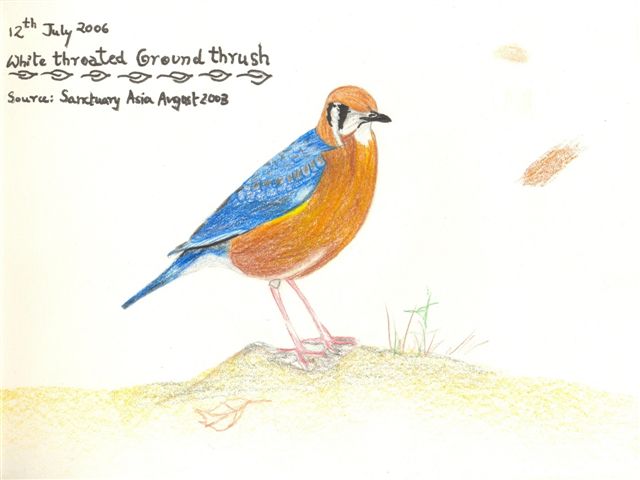
White throated Ground Thrush,
12th july 2006,
Source: Photo in Sanctuary Asia, August 2003
Sunday, June 25, 2006
Saturday, June 10, 2006
Touched by Thoreau – II
This was going to be a comment on Aasheesh’s beautiful post on Thoreau but my responses came in fractured slivers and turned out longish, so I thought they had better be put into a post.
Have you been touched by Thoreau? he had asked.
When I first read of Thoreau in school, his life in Walden, his eccentricities, his individual spirit, he felt like a kindred soul. Everybody has Guardian Angels and he seemed like he could be mine.
Many years later, I was stuck in a job and in a life I disliked, feeling trapped and very unhappy. I had wandered into that situation and had no idea how I must extricate myself, whether I must and indeed, if I could. Then:
+++
Talk of Thoreau inevitably calls up another memory. I must’ve encountered Enid Blyton’s Tammylan around the same time I met Thoreau and to my young mind, they frequently meshed.
Siblings Rory, Sheila, Benjy and Penny go to live in the country in Blyton’s The Children of the Cherry Tree Farm where they encounter wild man Tammylan. As they become friends, Tammylan introduces the children to the inhabitants of the English countryside: rabbits, hares, badgers, otters, foxes, voles and squirrels. It is one of my most-loved books, but most of all, I fell in love with Tammylan’s homes, both of them. One, a cave for the colder months and a tree house for the summer that I would have given anything to live in.
++++
In Wildness is the preservation of the World.
‘Wildness’ (with the extra whump) reminds me of this book I enjoyed recently and a small aside in the story that captured my imagination even as it saddened me. Percy Jackson and the Olympians: The Lightning Thief by Rick Riordan is a fantasy for young people, in which contemporary USA meets the Greek Pantheon. Racy and very entertaining.
But the aside that interests us comes from Grover, a satyr in the tale who is, like many satyrs before him, desperately seeking a Searcher’s License. The search is on for Pan, the God of Wild Places. Even as they speak, our hero Perseus feels a change in the air.
+++
Not one mention of a bird here, or birding, and this a blog about birding! But I plead your indulgence and quote in my defence CLR James who said: ‘What do they know of cricket who only of cricket know?’ So it is with birders – our interests scatter wide and how do you stop a ripple?
Have you been touched by Thoreau? he had asked.
When I first read of Thoreau in school, his life in Walden, his eccentricities, his individual spirit, he felt like a kindred soul. Everybody has Guardian Angels and he seemed like he could be mine.
Many years later, I was stuck in a job and in a life I disliked, feeling trapped and very unhappy. I had wandered into that situation and had no idea how I must extricate myself, whether I must and indeed, if I could. Then:
I have learned, that if one advances confidently in the direction of his dreams, and endeavors to live the life he has imagined, he will meet with a success unexpected in common hours.I had only Henry David’s word for it. I had been having altogether too many ‘common hours’ but then I thought, he must know. With that one sentence drumming in my mind, I escaped the life I had so dreaded and since have indeed met with success I could not hope for then.
+++
Talk of Thoreau inevitably calls up another memory. I must’ve encountered Enid Blyton’s Tammylan around the same time I met Thoreau and to my young mind, they frequently meshed.
Siblings Rory, Sheila, Benjy and Penny go to live in the country in Blyton’s The Children of the Cherry Tree Farm where they encounter wild man Tammylan. As they become friends, Tammylan introduces the children to the inhabitants of the English countryside: rabbits, hares, badgers, otters, foxes, voles and squirrels. It is one of my most-loved books, but most of all, I fell in love with Tammylan’s homes, both of them. One, a cave for the colder months and a tree house for the summer that I would have given anything to live in.
It was by a backwater of the river – a quiet peaceful place, where moor-hens bobbed about and fishes jumped for flies. “A Tammylanny sort of place,” Benjy thought to himself…
It was a most extraordinary house. Tammylan had planted quick-growing willows close to one another, and used their trunks for walls. He had trained the top of these branches across for a roof! Between the trunks of the willows he had woven long, pliable willow twigs, and had stuffed up all the cracks with heather and moss. It was the cosiest house imaginable.To me, Thoreau's cabin at Walden has always seemed like that tree house. Very one's own.
++++
In Wildness is the preservation of the World.
‘Wildness’ (with the extra whump) reminds me of this book I enjoyed recently and a small aside in the story that captured my imagination even as it saddened me. Percy Jackson and the Olympians: The Lightning Thief by Rick Riordan is a fantasy for young people, in which contemporary USA meets the Greek Pantheon. Racy and very entertaining.
But the aside that interests us comes from Grover, a satyr in the tale who is, like many satyrs before him, desperately seeking a Searcher’s License. The search is on for Pan, the God of Wild Places. Even as they speak, our hero Perseus feels a change in the air.
A strange breeze rustled through the clearing, temporarily overpowering the stink of trash and muck. It brought the smell of berries and wildflowers and clean rainwater, things that might’ve once been in these woods. Suddenly, I was nostalgic for something I’d never known.In Greek mythology, Pan is the only god who is supposed to have died. However, the news was dubious, though certainly Pan seemed to have disappeared. Grover explains his quest:
When humans heard the news, they believed it. They’ve been pillaging Pan’s kingdom ever since. But for the satyrs, Pan was our lord and master. He protected us and the wild places of the earth. We refuse to believe that he died. In every generation, the bravest satyrs pledge their lives to finding Pan. They search the earth, exploring all the wildest places, hoping to find where he is hidden and wake him up from his sleep.All those years ago, Thoreau was right: the preservation of our world does depend on how well we protect Pan’s domain. Wake up, Pan-God, reclaim your kingdom. Before it is too late.
+++
Not one mention of a bird here, or birding, and this a blog about birding! But I plead your indulgence and quote in my defence CLR James who said: ‘What do they know of cricket who only of cricket know?’ So it is with birders – our interests scatter wide and how do you stop a ripple?
Tuesday, June 06, 2006
Touched by Thoreau
"In Wildness is the preservation of the World."Those words cleaved their way forcefully into my being in 1983, the first time I read the great sage of the woods. I had bought a copy of his 'works' at a book sale in Bharatpur, yes, my first visit to that avian shrine, and on returning to Hyderabad, spent numberless hours, blissfully sipping such verbal novelties, such novel ideas, written with a pen that seemed to spring from my very heart, that I trembled unabashedly in the passion and ardor of the author. I feel that the lodestone of his philosophy is encapsulated in this immortal phrase.
Notice, the great man used the word "Wildness", with a capital 'W' and not 'wilderness' as he is often misquoted to have done. That word, 'Wildness' has that extra whump to it, which transcends it into a meaning that is completely different from 'wilderness'.
I have read him whenever my fancy yearned for it or when my beliefs tottered in this material world, between the here-and-now of unfettered consumerism and the purity, the virginity and strength of Thoreau's Wildness, I found myself standing penitent in front of the bookshelf, tilting the masterwork into by palm, reading the tome from the page that fell open, instantly mesmerised, purified, calmed by the clarity and simplicity of his language.
"I believe in the forest, and in the meadow, and in the night in which the corn grows. We require an infusion of hemlock spruce or arbor-vitae in our tea."
"Life consists with wildness. The most alive is the wildest. Not yet subdued to man, its presence refreshes him."
"Here is this vast, savage, howling mother of ours, Nature, lying all around, with such beauty, and such affection for her children, as the leopard; and yet we are so early weaned from her breast to society, to that culture which is exclusively an interaction of man on man, -- a sort of breeding in and in, which produces at most a merely English nobility, a civilization destined to have a speedy limit."
American nature writers are a class in themselves and Thoreau their godfather.
Notice, the great man used the word "Wildness", with a capital 'W' and not 'wilderness' as he is often misquoted to have done. That word, 'Wildness' has that extra whump to it, which transcends it into a meaning that is completely different from 'wilderness'.
I have read him whenever my fancy yearned for it or when my beliefs tottered in this material world, between the here-and-now of unfettered consumerism and the purity, the virginity and strength of Thoreau's Wildness, I found myself standing penitent in front of the bookshelf, tilting the masterwork into by palm, reading the tome from the page that fell open, instantly mesmerised, purified, calmed by the clarity and simplicity of his language.
"I believe in the forest, and in the meadow, and in the night in which the corn grows. We require an infusion of hemlock spruce or arbor-vitae in our tea."
"Life consists with wildness. The most alive is the wildest. Not yet subdued to man, its presence refreshes him."
"Here is this vast, savage, howling mother of ours, Nature, lying all around, with such beauty, and such affection for her children, as the leopard; and yet we are so early weaned from her breast to society, to that culture which is exclusively an interaction of man on man, -- a sort of breeding in and in, which produces at most a merely English nobility, a civilization destined to have a speedy limit."
American nature writers are a class in themselves and Thoreau their godfather.
Thursday, May 11, 2006
History lesson

I’ve been reading Stephen Moss’s A Bird in the Bush these past days, which as the tagline says is a social history of birdwatching.
This is a highly informative book, rich in anecdote and birding lore. My one grouse is it is predominantly Britain-centric apart from some references to developments in the Americas, mostly North of course. However, once I’d put that disappointment behind me, I was absorbed by the view this book afforded me of birders and birdwatching in times other than this one, in their context, their mileau, with their values and resources.
Starting with the Reverend Gilbert White who made his home patch so memorable with his work The Natural History of Selbourne to the latest advances in bird ringing technology and optics today, Moss traces it all. He also peppers his account with passages by birders and naturalists and it serves to vividly bring their times to light, not merely by what they're saying but with how they're saying it as well. Birders, if these quotes are anything to go by, seem to make charming raconteurs, because these men are articulate, prone to description and frequently poetic. I'm taking the liberty of quoting a few pieces here because they're so telling.
For most of us today, birding is also a social activity. There is an insistent feeling of community flowing along a line of birders with their bins raised to the flighted ones.
The companionship too of those who are prosecuting with zeal and enthusiasm the same path of science, is not the least delightful feature of such excursions... the pleasing incidents that diversified the walk, the jokes that passed, and even the very mishaps or annoyances that occurred – all became objects of interest, and unite the members of the party by ties of no ordinary kind.That doesn’t mean to say that it can’t be enjoyed alone, of course; it is glorious to be on your own, feeling the sun on your shoulders and all the time in the world at your command as you commune with a woodpecker, or even an owl:
JH Balfour, on a similar pursuit, the search for rare flowers.
Before that moment I had, like every young keen birder, compensated for experiences of the real thing with long hours poring over bird books and bird pictures. But on Goldsitch Moss I realised, perhaps for the first time, by how much life can exceed imagination. A Short-eared Owl had entered my life and for those moments, as it swallowed me up with its piercing eyes, I had entered the life of an owl. It was a perfect consummation.
Mark Cocker, Birder: Tales of a Tribe
However, there are times when you must, absolutely must have someone to tell what remarkable birds you saw that morning. And so, it was curious for me to see the loneliness that hung over many early birders. It was oddly brave of those early birders to persist in birding in complete isolation, in making meticulous notes of habitats, markings and observations in a time when it cast you in dubious light to carry field glasses (only race-goers sported them, apparently).
It has long been my misfortune never to have had any neighbours whose studies have led them towards the pursuit of natural knowledge; so that, for want of a companion to quicken my industry and sharpen my attention, I have made but slender progress…
Gilbert White
It was a bit shocking to know that even as close as the early 1970s, there were closet birders.
At the time, sex, drugs and rock’n’roll were far more alluring… As such, the last thing I would mention to anyone was that I enjoyed watching birds – it just wasn’t, well, cool!
Neil McKillop
It was the standard joke when people heard I was interested in birds – ‘oh, the two-legged kind, I hope!’… That kind of constant crass innuendo made me wary about disclosing my bird interests.Moss talks at length also of the shotgun naturalists and the egg-collectors – a period that by the simple expedient of holding the (dead) bird in hand, added much to the collective pool of scientific knowledge – and the social and ecological values that led to their condemnation.
Mark Cocker
Particularly thrilling for me were accounts of young men in Britain and America who stepped out to explore their worlds with dogged single-mindedness. Specially the story of American birder Kenn Kaufman, who at the age of 17 dropped out of high school and took off with fifty dollars in his pocket to travel his country looking for birds. Then there were Britons Nigel Redman and Chris Murphy who charted a 10-month epic journey of more than five thousand miles from Britain to Nepal via Europe, Turkey, Iran, Pakistan, Afghanistan and India.
Moss presents the debates around the more recent day obsession with twitching also. Even as I wondered at listers for not seeing the woods for the trees in their pursuit of another tick, I couldn’t help gasp at Phoebe Snetsinger and her haul of 8500 species when she died in 1999. Diagnosed with cancer and told that she had less than one year to live, she fought back and continued in her quest for ‘lifers’ till she died in a freak bus accident in Madagascar.
The book narrates many such stories, engrossing to anyone who’s interested in how birding came to be what it is today. Fascinating stuff.
___
A Bird in the Bush: A Social History of Birdwatching
Stephen Moss (2004)
Aurum Press, London
Wednesday, May 03, 2006
Close encounters of the bird kind
The best moments in birding are probably when you get so close to birds that you can reach out and touch them. Our garden and the Gulmohar tree growing in front of our home, is frequented by Koels, Ashy prinias, Sunbirds and Red-vented Bulbuls. I have seen bulbuls pluck caterpillars from the Oleander tree and bang them on the wall and eat them from a meter away. The Ashy prinias are the best. If you sit still enough the bird comes to you. Calling out its jingling and chiming notes merrily. After mum waters the plants a prinia comes regularly to drink water from little pools and drops dripping from the ferns. Once it hopped across the little garden and came ever so close to me, that I could see every feather and every mark on its body. Give a sudden jerk and it flits away into the neighbour’s garden, out of sight. The morning glory creeper gives a shudder and you know it’s another Prinia bouncing among the tendrils. The creeper hides our drawing room window, so you can see the bird from the room separated only by a glass pane. The bird is totally oblivious to your presence and goes on hopping about and suddenly stops directly in front of you and you are staring it in its eye. I love these close encounters and every time they happen I can't stop smiling for the rest of the day! And recently a Prinia was stitching two leaves together in the Ixora tree with a strand of dry grass. I could see it punching holes in the two leaves with its beak. It however abandoned making the nest. Perhaps the leaves were too tough to hold together.
Subscribe to:
Posts (Atom)